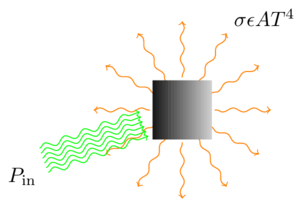
It's been far too long since I did a Mythbusters writeup, but I think it's time to stop stalling and bring this series back. On this week's episode, Adam and Jamie tested the myth of Archimedes' heat ray for a third time — that has to be some kind of record — at the request of President Obama.
The gist of the myth is this: by focusing enough of the sun's rays, using a large number of mirrors, on an enemy ship, the Greeks hoped to heat it up enough to make it catch on fire. So far (spoiler alert), there's no evidence that this thing ever could have worked. All three of the Mythbusters' tests have failed.
But I think I can shed some light (no pun intended) on why. As it happens, I taught a lab on thermal radiation transfer this week, and that (along with an interesting perspective on gravitationally baking a turkey) reminded me that it's fairly straightforward to calculate, at least in a simple model, the amount of radiation it takes to heat something up to a particular temperature. It all stems from the Stefan-Boltzmann equation,

This equation actually serves a dual purpose: it tells you the rate at which an object at temperature
loses energy due to thermal radiation alone (not counting other effects like heat conduction), and it also tells you the rate at which an object in an environment at temperature
gains energy from that environment, again due to thermal radiation alone. In either case,
is the Stefan-Boltzmann constant,
is the object's surface area, and
is the object's emissivity. Since any real object will be both emitting and absorbing radiation, the two uses of the equation are often combined to give the net power loss due to thermal radiation:

Here I'm using
to designate the temperature of the environment, and plain
is the temperature of the object.

So here's the simple model. Suppose that the piece of the ship you're trying to set on fire is effectively insulated, so that it doesn't gain or lose heat by conduction. (The parts of a ship that you'd try to set on fire, the sails or perhaps the wooden hull, generally don't conduct heat very well; besides, the problem gets a lot harder if you relax this assumption.) The piece will lose energy through thermal radiation, at a rate determined by the equation above, and it will gain energy from the sunlight being focused on it. When it's at thermal equilibrium (which it essentially always is), those two will be equal,

If the equilibrium temperature
is greater than or equal to the flash point of the material, it catches on fire. Simple enough.
The final piece of the calculation involves figuring out the power input from sunlight. This is just going to be the solar irradiance
, representing the power of sunlight per unit area, times the area
of the mirrors used to reflect the light, times the cosine of the angle of incidence of the sunlight, times the reflectivity of those mirrors,
.

But to get the amount of this sunlight that actually reaches the sail, we need to throw in a couple of extra factors. First, since the aiming of the mirrors is not perfect, we'll need a number
representing the fraction of mirrors that were actually reflecting their light to the right place. Also, since some of the radiation reaching the sail will be reflected, only a fraction of it actually goes towards heating the sail, so we need to multiply in the absorptivity
of the sail's material. Putting it all together, we come up with this expression,

giving the following for the area of mirrors required:

So it's time to plug in some numbers.
Let's start with the Mythbusters' most recent test:
on a side, with an area of
.
, or
.
, or
(although this number is not going to matter much once you take the fourth power).
(that's around
); perhaps it was a little more in reality.
.
.
.
. (no surprise there...)
: 80% of the mirrors are correctly aligned to reflect on to the target.
.Plugging in all the numbers, I come up with
for the required surface area of the mirrors.
Hm... that's not very much. The 500 mirrors would have had no problem setting the boat on fire. Clearly something is wrong with this calculation. A couple of things come to mind almost immediately: perhaps the absorptivity of the sail was actually lower, so that it reflected more sunlight. Perhaps its emissivity was higher, so that it was more efficient at radiating away excess energy. Perhaps the fraction of mirrors on target was lower than
(and I can't really blame the kids, those mirrors were nearly as big as some of them were).
Digging a little deeper, it's possible that the attenuation of sunlight by the atmosphere was more than the ASTM spectrum accounts for, although I wouldn't expect this to have been a big issue. The ASTM spectrum models the radiation received when the sun is about
above the horizon, and based on my observations from the show, the sun was pretty close to that inclination when they did the experiment. Admittedly the pressure, humidity, etc. at the test site were certainly different from the ASTM reference values, but again, I don't see that making a huge difference.
Another thing to consider is that several of the values I included in the formula are actually wavelength-dependent, namely emissivity, absorptivity, and reflectivity, as well as the spectral irradiance from the sun. So the incoming power should really be expressed as a function of the wavelength of the light and the angle,

The same goes for the thermal equilibrium condition, although it's still the total power that determines whether the temperature changes,

Putting these together makes the mirror area formula look much more complicated:
![A_\text{mirror} = \frac{\sigma A_\text{target}\cos\theta}{n}(T_f^4 - T_0^4)\biggl[\int\frac{\epsilon(\lambda)\udc\lambda}{I(\lambda)\mathcal{A}(\lambda)\rho(\lambda)}\biggr]^{-1}](/images/latex/7a64514235b4dc381ab67113fbb67c61.png)
But usually, it's reasonable to approximate the functions of
as constant over the range of wavelengths we're dealing with, so I doubt that this would account for the two-orders-of-magnitude error in my result. (If you have access to a lot of data on optical properties of various materials, feel free to plug this thing into a computer and find a value for it to see whether that's in fact the case.)
Honestly, though, I think the biggest problem the model doesn't work is that I completely ignored other ways in which heat is removed from the target. Specifically, heat loss to the surrounding air is likely to be a major factor, because convection can carry away a lot of energy. I'm going to say that working out exactly how fast energy is lost this way is "beyond the scope of this post" — that is, either impossible or more work than I have time for ;-) But we can make a quick estimate by modifying our equation to include a generic heat loss term,

Plugging in the other formulas from before, I get

Now, with the numbers previously estimated and using
for the total area of all the mirrors (should be within a factor of 2, right?) gives

That's kind of a lot. Wait — is it a lot? Well, if you calculate the total power that should be coming in from the sun, you get
(and I think that formula can be trusted). So if this is correct, the sail is incredibly efficient at radiating away the energy it receives from sunlight; a mere 1% of the incident energy in this situation actually goes into heating it up! No wonder it's such a hard thing to pull off.
Exploding grease, exploding microwave ovens, exploding cheese — it's a Mythbusters fan's dream episode :-) Of course, where there are explosions, there's physics, and the latest episode of Mythbusters is no exception.
Here's one: you can't blow up C-4 by microwaving it. Kari explained in the show that this is because C-4 is a plastic explosive, and microwaves are designed to pass through plastics (as well as metal and glass). So how exactly does that work?
Microwaves heat food by a process called dielectric heating, which generally refers to the ability of many materials to absorb energy from electromagnetic radiation passing through them. Physically, an electromagnetic wave consists of rapidly oscillating electric and magnetic fields. These fields (well, primarily the electric field) exert forces on the charged particles that make up all matter — since the fields are oscillating, so do the forces. Essentially, an electromagnetic wave makes atoms and molecules rapidly jiggle back and forth, and as they do so, they bump into other nearby atoms and molecules, transferring kinetic energy to them and raising their temperature. Of course, if the atoms and molecules are gaining energy, that energy must be coming from somewhere, and the electromagnetic wave is the only source — this is how energy gets transferred from the microwaves to, say, food.
But why doesn't this work just as well for C-4? To answer that question, we need the mathematical description of just how much power gets transferred from the waves to the matter. (This calculation is not for the faint of heart, so feel free to skip to the last paragraph) The behavior of electromagnetic fields in matter is characterized by two numbers, the permittivity (for electric fields) and the permeability (for magnetic fields). Permittivity is defined as the proportionality constant that relates the electric field
to the "displacement field"
(which, roughly speaking, represents the "net" electric field in a material after you account for the material's polarization). In other words (letters):

This is simple enough when the electric field is static. But when it's not, as in an electromagnetic wave, the changes in the displacement field lag behind the changes in the electric field due to the amount of time it takes for the molecules of the material to change polarization. We represent this using a phase difference,
![\realop[\vec{D}_0 e^{-i\omega t}] = \realop[\epsilon e^{i\delta_E}\vec{E}e^{-i\omega t}]](/common/images/latex/4f97371b238c5913ac7580bec9af8bb2.png)
is the phase difference, which is generally a function of the frequency
. There's a similar equation for magnetic field and permeability,
![\realop[\vec{H}_0 e^{-i\omega t}] = \realop[\epsilon e^{i\delta_B}\vec{B}e^{-i\omega t}]](/common/images/latex/7079eefdf6b6fe140b6bd0371bb02ab0.png)
These two quantities can be plugged into Poynting's theorem which describes the propagation of electromagnetic energy. The equation is

where the first two terms tell you how much electric and magnetic energy (density), respectively, get transferred to the material. (The last term tells you how much passes on through.) So for our purposes,
![\expect{\frac{1}{4\pi}\vec{E}\cdot\pd{\vec{D}}{t}} = \frac{1}{4\pi}\expect{\realop[\vec{E}_0 e^{-i\omega t}] + \realop[(-i\omega)\epsilon e^{i\delta_E} \vec{E_0} e^{i\omega t}]} = \frac{1}{8\pi}\abs{E_0}^2\omega \epsilon\sin\delta_E](/common/images/latex/2bd09638f1bbe28a1b9eb9f157e5a3cf.png)
and similarly,

Now, it happens that, for many common materials,
and
, which means that the magnetic energy isn't absorbed very much in the material. So the power per unit volume dissipated by the radiation is pretty much just

Sometimes you may see
written as
, the imaginary part of the complex permittivity.
Now, getting back to the big picture: that last formula shows that the power dissipation in a material depends on the intensity
and frequency
of the electromagnetic radiation, as well as the permittivity
and phase delay
of the material. It's the latter two that explain why C-4 barely heats up in the microwave. Materials like glass and plastic (including C-4) consist of large molecules which (1) are more or less fixed in place, and (2) have very little dipole moment, which means that they don't polarize very much in an electric field. Remember that the permittivity is the ratio between polarization and electric field, so if a material doesn't get polarized much, it will have a low permittivity (small
), which in turn means that not much power is absorbed from the microwave radiation. On the other hand, liquid water, and to a lesser extent fats and sugars, are more easily polarized, which means they have higher permittivities and will absorb more energy from the microwaves. Metals, as conductors, have the largest responses to an applied electric field — you can get large numbers of electrons zipping back and forth along a piece of wire in an electric field, and this is what caused the sparking, and eventual explosion, seen on Mythbusters.