2011
May
18

Blow your own sail

The latest episode of Mythbusters tested a slightly controversial and very physics-related myth: that you can propel a boat forward by putting a fan on the boat and pointing it forward, into the sail. What's going on here?

First of all, why wouldn't you expect this to work? Actually, first of all, why would you expect this to work? Think about the naive explanation for why a sailboat moves: the wind pushes forward on the sail, and the sail pushes forward on the boat. So someone who had never heard of physics might think that putting a fan on the boat and pointing it into the sail just gives you a convenient, portable source of wind. Presto, instant speedboat!

But, as explained on the show, that reasoning doesn't work, because of Newton's laws of motion. There are actually a couple of different ways to apply Newton's laws to this scenario:

  • Newton's first and second laws (which are kind of the same thing) say that an object maintains its state of motion unless subject to an external force. The key word there is "external": if you want your boat to move, you need something outside of the boat to provide the force. Natural wind can do that, but not a fan on the boat itself; that's an internal force.
  • For a more detailed description, consider Newton's third law, which says that forces occur in complementary pairs: If object A exerts a force on object B, then object B exerts an equal and opposite force on object A. In this case, the objects are the air and the fan. In order to blow the sail, the fan needs to push the air, which means the air pushes back on the fan. And since the fan and the sail have opposite effects on the air (the fan takes it from still to moving, the sail takes it from moving to still), the forces from the fan and from the sail exactly cancel each other out.

If you watched the episode, of course, you know that blowing your own sail actually does work (a little) in practice. So what's wrong with the preceding argument? Well, the air exerts a forward force on the sail and a backward force on the fan, and I initially assumed that those cancel out. But in reality, they don't, because the sail doesn't just stop the air, it reflects it. It takes more force to bounce something backwards than it does to just stop it — twice as much, in fact, because of Newton's second law in the form F_\text{avg} = \frac{\Delta p}{\Delta t} (reflecting an object takes the momentum from p to -p, which is twice as much change as p to 0). So the force on the sail, which has to make air molecules bounce backwards, is greater than the force on the fan, which just has to make them accelerate from rest.

Or is it? Actually, if you think about it, what happens to that reverse airflow coming off the sail? Yep, it heads right back toward the fan. So the fan isn't just accelerating air from rest; it potentially has to take the air that was moving backward (from the sail) and change its direction to move forward. This represents a change in momentum from -p to p, which exactly cancels out the effect of the sail, assuming the same amount of air is involved.

This is why the overall effect of blowing your own sail depends on how much air is moved by the fan, relative to the amount that's reflected by the sail. As we saw in the show, if the sail is much smaller than the fan, then the fan blows more air than the sail can reflect, so the force on the fan is greater, and the boat moves backward. But if the sail is much larger than the fan, then the fan isn't able to capture all the air reflected by the sail, so the force on the sail is greater, and the boat moves forward. And if the fan and the sail are reasonably close to the same size (or the sail is only slightly bigger than the fan), then the fan can capture essentially all of the air reflected back by the sail, and the forces roughly balance out.

It's interesting to notice that if you treat the combination of the fan and sail (and the air between them) as a "black box," you'll notice that when the boat moves backwards, it's emitting an air stream forwards, and vice versa. So the fan and sail act almost like a rocket: they propel the boat by emitting a stream of exhaust gases in the opposite direction, except that the exhaust gas is air instead of burnt rocket fuel. Still, at best this stream contains only get a fraction of the air being blown by the fan, so for the most efficient propulsion, it really is better to just point the fan backwards to begin with.

Or in true Mythbusters fashion, mount a rocket on the boat. But that's a story for another day.

2010
Apr
06

Shockwave reflection

The latest episode of Mythbusters features a myth with a deep physical explanation... no pun intended! Well, maybe. Anyway, the myth is that by diving under the water, you can escape injury from an explosion occurring above the surface. Adam and Jamie tried to solve this puzzle by experiment (what else), and their results seemed to show that the myth might actually be true, but I want to look at it from the theoretical standpoint: why might being underwater protect you from an explosion?

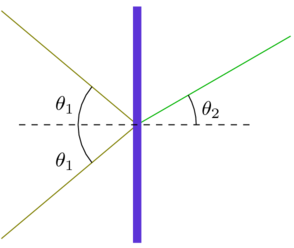
There is actually a not-too-obscure answer to this puzzle, and it has to do with refraction and reflection. These are phenomena that occur when a wave (of any sort — light, sound, or whatever) crosses a boundary between two media in which it has different speeds. Part of the wave bounces back (that's reflection) and part of it continues through, but in a different direction (that's refraction). Exactly how much of the wave's power is reflected and how much is transmitted through, as well as the new direction of the transmitted part, depends on the angle of the incoming wave with respect to the surface, and also on the relative speed of the wave in the two materials.

Reflection and refraction of waves

Reflection and refraction are most often discussed in connection with light. Lenses, for example, work by refracting incoming light, since light travels slower in glass (or plastic) than in air. Because the surface of the lens is curved, it bends different light rays in different locations by different amounts, and this can be used to focus an image. But the same thing happens with pressure waves, like sound waves and explosive shockwaves, at the surface of a lake, because pressure waves travel faster in water than they do in air. It stands to reason, then, that part of the energy in a blast wave would be reflected off the surface of the lake, reducing the energy available to damage anyone (or anything) below the water.

Unfortunately, calculating how much energy is reflected and how much is transmitted when a shock wave hits water turns out to be a very involved problem, not something that can be learned and solved in a week ;-) Still, there are some qualitative things I can say about the process. Consider what happens to a pressure wave in air when it hits a boundary, such as a wall: the wall will vibrate a bit, but the wave mostly just bounces back. You'd expect that a similar sort of thing would happen if the wave hits a water surface instead, since compared to air, water is very "hard" — technically speaking, it has a very low compressibility. This is related to a material property called the bulk modulus, which basically measures how much the material resists being squashed (compressed). The bulk modulus of water is about 10000 times larger than that of air, so the increase in pressure applied by a wave will have a relatively minor effect on the water. It'll have a much greater effect on the surrounding air, which means that that's where most of the energy goes: back into the air.

If pressure waves don't affect water that much, though, why was there such a huge splash every time the Mythbusters set off one of their explosions? The amount of energy in an explosion shockwave is so large that even "relatively minor" can be enough to throw a lot of water around! Since air is transparent, most of the wave's effect on the air goes unnoticed.