http://scienceblogs.com/dotphysics/2010/06/collisions_kinetic_energy_or_m.php
Took the words right out of my mouth. Or right off my keyboard. Whatever. I'm just happy to see other people are considering the same questions.
But I've got a couple of things to add. First of all, kinetic energy can be easily related to momentum using the formula

which tells you directly that an object with the same energy but larger mass will have a larger momentum.
Also, the big question: is it energy or momentum that gives a collision its decapitating power? My thought is that it actually depends on force. Think about this from the point of view of a particle in the neck. This particle doesn't "know" (as if a particle could "know" anything) how big the sheet of glass hitting it is; it doesn't "know" how much energy or momentum the glass has. The reason is that energy and momentum are what I'm going to call global properties, basically meaning that the total amount of them possessed by some object comes from contributions from all different pieces of the object. To measure a global property of the glass, you need to have access to the entire piece of glass. But a particle in the neck doesn't have that access; it only interacts with a few atoms on the edge, so those are the only ones that can influence it. This means that whatever happens to the neck must be determined by local properties, which can be measured at a point, without having access to the entire piece of glass. And the relevant local property is force. (Think about it: when you feel a force from something pushing on you, you can tell how strong the force is without knowing anything about the object exerting it.)
But of course there's a little more to it than that. The ability to cut through a neck doesn't just depend on the glass being able to exert enough force; it also requires sufficient force to be maintained across the full diameter of the neck. When the glass first hits the neck, it exerts some force on the neck, which cuts through the first layer of skin, but the neck also exerts the same amount of force on the glass, which slows it down. (Newton's third law) Since the glass is moving more slowly, it's going to exert less force on the next layer of skin. The further it goes through the neck, the slower the glass is moving and the less cutting force it exerts. In order to make a clean decapitation, this continual decrease in speed has to leave the glass moving fast enough to cut through a layer of skin after it's made it all the way through the rest of the neck.
I can even apply some math to this, although there's not quite enough information to make a precise calculation. Here's what I do know. The force
on the glass changes the glass's momentum according to Newton's second law,
(this is only in one dimension, so I don't need to make the variables vectors, but I do need to be careful with signs). Momentum is, of course,
, and I can use that and the chain rule to write

So I know how the force affects the glass's speed. That's just general Newtonian dynamics. What I don't know is how the speed affects the force. In other words, how much force does the neck exert on the pane of glass, as a function of their relative speed? If I knew that function,
, I could plug it in to the previous equation and solve the differential equation for
.
To show how that would work, I'm going to make up an example function
, completely out of thin air. Well, not completely out of thin air — I'm going to take the function from... thin air ;-) If you've read my previous posts, you may remember the equation for the aerodynamic drag force,

This is precisely the kind of equation we'd want: the force of resistance, as a function of speed, on a solid object moving through some stuff. Specifically, a fluid. Of course, a neck is hardly fluid-like, but this is just an example so it'll do the job. (You have a better idea?)

In this situation
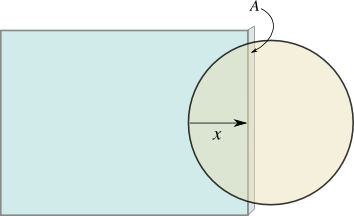
can be the cross-sectional area of the glass that is in contact with the neck, and
will be the volume mass density of neck material (that's mass per unit volume). But
depends on the full 3D position, so it's be easier to consider the product of
, which is the linear mass density along the direction that the glass moves — in other words,
is the mass per unit
-distance that the glass cuts through. It's a function of only
, not the other coordinates.
If you combine the drag equation with the dynamic equation above it, you get

The negative sign is necessary because the force points in the negative direction. This is a separable differential equation, so we can rearrange it to

and integrate it to get

is the total length of the neck that the glass cuts through. (Or you could make
be some distance partway through the neck, if you wanted to find the glass's speed there) I started writing
as
to remind us that it varies with position, and same with
. Now I can solve for
, the final speed, in terms of
, the known initial speed, and I get

So what does this have to say about the original question? Does a larger piece of glass with the same energy have the same decapitating power?
Well, there's no reason to expect this formula to be accurate, given all the unjustified assumptions that went into deriving it. But on the other hand, I'd expect that it would have some tenuous relation to reality. If you increase the mass of the neck (say, by making it denser, increasing
), the equation says the glass loses more speed, which makes sense. And if you increase the mass of the glass, the equation says it retains its speed better, which also makes sense.
Let's try this out with the Mythbusters' actual experiment. They tried to simulate the effect of the piece of glass Tory threw, with mass
, if it were moving at a speed of
, or
. According to the calculations they did on the show, that has an energy of
, and the mass required to reproduce that energy at
is
. So we have two sets of parameters:


The quantity
is going to be the same in both cases. Let me call that
since it has the units of mass. If I plug in the parameters just listed, I get


Hmm, so this definitely depends on
. Which I don't know. But if you think about it,
is basically the mass of neck that the glass cuts through, with some scale factor (related to the "drag coefficient"
) that's probably between
and
. (I don't actually know, I'm just guessing here) A window-thin piece of neck probably has a mass of
or less, which means that
is likely less than
. Now look at this plot of
for various values of
in that range:

The top curve is for the smaller piece of glass, the one Tory threw, and the bottom line is for the larger piece they put on the truck. Clearly, for this range of values for
, the smaller piece has a much higher final velocity, and that indicates a much higher decapitating power.
The Mythbusters are back! In their first episode of the new season, Adam and Jamie tested the myth that a cup of soda casually thrown out a car on the highway can smash through a windshield and kill the person sitting behind it. (Technically busted, but still really dangerous!)
One of the major factors that determines whether or not a projectile (like the cup of soda) will be able to smash a windshield is the force exerted by the cup on the glass. On the show, the Mythbusters used a piezoelectric force sensor to directly measure the force exerted when a cup of soda/ice/slush impacted on a steel plate, but we can also try to calculate the force using Newton's second law,

First some simplifying assumptions are in order. I'm going to start by assuming that (1) each part of the cup and its contents continues to move at constant velocity up to the moment it impacts the plate, and that (2) after impacting the plate, the soda/ice/slush flies out in a direction perpendicular to its initial trajectory, along the plane of the plate. Of course, I wouldn't expect that either of these assumptions would be correct in reality, but let's see where they take us.
In order to calculate the force using Newton's second law, we'll need to know the change in momentum in the direction in which the force is exerted, as well the time it takes that momentum to change. The change in momentum is easy enough: we're given the mass of the cup and its velocity on its way into the collision, and under assumption (2), the final momentum in the direction of the force is zero, so the change in momentum — or impulse — is just

Assumption (1) allows us to calculate the amount of time the collision takes as
, where
is the length of the cup. Basically we're assuming that the collision time is the same as the time it would take for the length of the cup to pass by the target plate. Putting these together, we can find the average exerted force as

Notice that just as Jamie predicted on the show, the force (in this approximation) is proportional to mass. Higher mass means higher force.
The Mythbusters were kind enough to post their data for
and
, and together with my estimate of
, I can calculate the average force that this model predicts for each cup. Here's the math:


The experimental results from the show were, respectively,
,
, and
. Not too bad of an estimate, given our rough assumptions! I do notice that the result for soda is a lot closer than for ice or slush, which I suspect is because ice and slush are made of harder pieces which would probably bounce back more than the liquid soda.
If you were paying attention, you might have noticed that the tests Adam and Jamie ran with the steel plate were not quite the same as the real situation — a car windshield is slanted at a pretty significant angle. That means that when a soda cup impacts the windshield, instead of flying off in the perpendicular direction, the soda (or slush, or ice) retains some of its forward momentum, meaning that the resulting force on the windshield is less than what was measured using the force sensor.
We can calculate just how much less using the same procedure as above, with one modification: the assumption that the contents of the cup flies off perpendicular to its initial trajectory has to be dropped, because that's obviously not what happens when a windshield is involved. Instead, I'll assume that the stuff in the cup slides along the windshield and off the top. That means that, as seen by the windshield (or by the hapless victim), the final momentum in the horizontal direction will be
instead of zero, where
is the angle of inclination of the windshield above the horizontal. That makes the impulse

and the force becomes

Notice that I've left the force in vector notation this time. That's because the breaking strength of a windshield would most likely be measured in terms of force exerted perpendicular to the glass, which is not the same as the horizontal force. (The parallel component of force doesn't really contribute to breakage). In order to compare the force we calculate to the reported breaking strength of a windshield, we're going to have to find that perpendicular component of force. Fortunately, it's not hard to do; all we need to do is take the dot product with the normal vector to the glass, which is
. The result is
![\abs{F_{\perp}} = \frac{mv^2}{\Delta x}[(\cos\theta - 1)\sin\theta - \sin\theta\cos\theta] = \frac{mv^2}{\Delta x}\sin\theta](/common/images/latex/ab057d1b349724a82893b6d5b4fb7a51.png)
For a windshield inclined at, say, about
(I just guessed that), the
factor works out to about
, so the force exerted on a real windshield will be about that much times the equivalent force as measured by a force plate in the Mythbusters' setup.
Unfortunately, after going through all that, I've still been unable to find a numeric value for the breaking strength of a typical windshield to compare the calculation with. That's probably to be expected because whether a windshield will break depends on a lot more than just how much force is applied to it; things like the area covered by the impact and the time taken for the force to build up to full strength would probably also have an effect. And this is just a rough calculation anyway. In this case, the math doesn't have quite the same impact (no pun intended?) as the Mythbusters' demonstration!
On the last episode before breaking for Christmas, the Mythbusters build team undertook the slightly ambitious project of skipping a car across a pond, as shown in the movie Cannonball Run. At first this probably seems like a ridiculous thing to try — of course, on Mythbusters, what isn't? But this one actually worked. Here's a look at the rather interesting physics behind it.
As Jesse explained on the show, there are basically two physical principles that allow you to skip a stone (or a car) across water: the spin, and the reaction force of the water. This isn't buoyant force, like they've dealt with on previous shows; if buoyancy alone were the only thing pushing up on the stone, it'd float. Stones don't float. (Neither do cars.) The force that keeps a stone skipping across the water is related to its speed. Spin and speed, that's the magic formula.
First, the spin. Any spinning or rotating object has angular momentum, which is like a rotational equivalent of linear momentum: roughly speaking, it measures how difficult it is to change the object's motion. Objects with a lot of momentum are either very massive or moving very fast, or both, and in either case they're not going to change that motion easily. The corresponding formula for linear momentum is

showing that the rate of change of momentum is equal to the force, and for angular momentum,

showing that the rate of change of angular momentum is equal to the torque. Unless you have something pushing very hard on it, a rapidly spinning object is not going to change its spin by any significant amount in the short time involved in skipping across a pond. What's especially important here is that spin is a vector; it has a magnitude and a direction, and both of them are going to remain effectively constant. So in addition to continuing to spin at the same rate, a skipped stone will keep its spin axis pointing in the same direction, like a gyroscope. (Just kidding, try this) This is the purpose of spinning a stone when you skip it, so that it maintains the same orientation even as it gets jostled by the water. (It wasn't necessary to spin the car because its large mass keeps the water from flipping it over.)
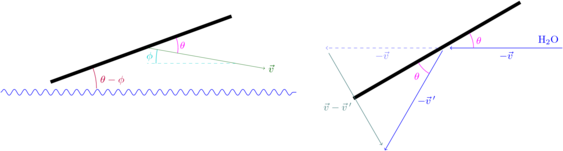
The big question, of course, is why a stone (or car) is able to bounce off the surface of the water at all. As you might guess, this has to do with the speed. Water bouncing off the bottom of the stone exerts an upward force on it, and the faster the motion, the larger the force. Working out a formula for this force is, if not outright difficult, a little tricky. We need to shift our perspective and imagine ourselves moving along with the stone at some particular instant — basically, instead of thinking about the stone hitting water at a velocity
, we consider a molecule of water hitting the stone with the same speed but in the opposite direction,
.

Suppose the molecule bounces off the stone elastically; that is, it keeps the same kinetic energy it had before the collision. That means it's going to have the same speed. Only the direction of the velocity changes, because the component of velocity perpendicular to the surface gets reversed; it's just like light bouncing off a mirror, and just like light, the angle of incidence will equal the angle of reflection. From the diagram, we can work out the final velocity of the water molecule,

and then the difference
![\vec{v} - \vec{v}' = v[1 - \cos(2\theta)]\unitx - v\sin(2\theta)\unity](/common/images/latex/61cc47c1766483275dd558a903e47cd8.png)
This quantity is important because when you multiply it by the mass of the water molecule,
, you get the momentum change of the water,
![\Delta \vec{p}_w = \mu_w\bigl[v\bigl(1 - \cos(2\theta)\bigr)\unitx - v\sin(2\theta)\unity\bigr]](/common/images/latex/8b55e061d0ba1f698791878879cf1503.png)
which is precisely equal and opposite to the change in momentum of the surface caused by this collision,
![\Delta \vec{p} = -\mu_w\bigl[v\bigl(1 - \cos(2\theta)\bigr)\unitx - v\sin(2\theta)\unity\bigr]](/common/images/latex/58dc992c2b1bea1c2421a69f99269b0b.png)
The next step is to figure out how many molecules are going to bounce off the surface per unit time. That's just the number density of molecules,
, times the volume the surface passes through in a unit time
, which is
. The dot product takes the component of velocity parallel to the area's normal vector, and it just works out to
, or
. Multiplying this by the change in momentum per molecule, we get
![\Delta \vec{p} = -\mu_w n A v\sin\theta \Delta t\bigl[v\bigl(1 - \cos(2\theta)\bigr)\unitx - v\sin(2\theta)\unity\bigr]](/common/images/latex/4d654cc843128ab32b35c7981168e497.png)
But notice that
, the mass density of the water. Dividing both sides by
, we get the force,
![\vec{F} = \frac{\Delta \vec{p}}{\Delta t} = -\rho A v^2\sin\theta\bigl[\bigl(1 - \cos(2\theta)\bigr)\unitx - \sin(2\theta)\unity\bigr]](/common/images/latex/9f607f33f6e1ecf0c640a8789ef546e3.png)
Hmm, this factor
looks familiar... we've just more or less rederived the equation for aerodynamic drag that pops up rather frequently in the Mythbusters' experiments.
There's one last thing to do with this expression before we can go on plugging in numbers. In the reference frame where the stone is at rest, we've been working in a rotated coordinate system, chosen so that the velocity
points directly along the
axis. But we want to find the vertical force that holds the stone up — that's vertical in the "stationary" reference frame, where the stone is moving and the water is not. Of course, I could just multiply the force we got by the appropriate rotation matrix. But instead I can use a little trick: I'll express all the vectors in terms of the directions defined by the problem itself. What I mean is, instead of writing
, use
, and instead of
, I'll invent a vector
which points perpendicular to
by definition. Unlike
and
, these vectors won't arbitrarily change their orientation when we switch coordinate systems. I can write the force as
![\vec{F} = -\rho A v^2\sin\theta\bigl[\bigl(1 - \cos(2\theta)\bigr)\unitvec{p} - \sin(2\theta)\unitvec{\eta}\bigr]](/common/images/latex/49bfb10e18a29f5646025e78d09c1757.png)
and from a drawing of the overall setup, I can easily tell that

and

Plugging in and simplifying,
![\vec{F} = -\rho A v^2\sin\theta\bigl[\bigl(1 - \cos(2\theta)\bigr)(\cos\phi\unitx - \sin\phi\unity) - \sin(2\theta)(\sin\phi\unitx + \cos\phi\unity)\bigr]](/common/images/latex/e5a5f0f1720dad5d51e44ce769196841.png)
which conveniently reduces down to
![\vec{F} = 2\rho A v^2\sin^2\theta[\cos(\theta - \phi)\unity - \sin(\theta - \phi)\unitx]](/common/images/latex/a62d268dbcb8d5a1c5b30984033f78e0.png)
If you look back at the diagram above, you'll notice that this vector describes a force which points perpendicular to the surface of the object being skipped — not to the surface of the water! I'll note that we could have arrived at the same conclusion using the coordinate-free form of the equation,

where
is the unit normal to the surface. The derivation is more or less the same as above, if you make some effort to represent all the vectors in terms of
and
from the beginning.
Anyway, now that we have an equation, it's time to calculate some numbers. Unfortunately, this is going to be the difficult part. It's easy enough to estimate
, that's just the speed of the car, and
is the density of water, but the other values depend on the exact shape and trajectory of the car, which are a completely separate issue from the calculation I'm talking about today. For our purposes, I'm just going to make some guesses based on what I remember seeing in the show.
First, let's consider the Mythbusters' attempt to replicate the circumstances of the movie: a (makeshift) luxury car flying off an 8 foot ramp at
. This car spun around in the air and hit the water nose-down, so the surface of interest is the front grill, which probably has an area around
. We can get an approximate measurement of
by looking at the video capture of the car (or perhaps by calculating it, but that's a topic for another day). Unfortunately, I don't have this video. So I'm just going to guess. At the point when the car hits the water, it's probably inclined by about
.
is a bit harder to determine, but it has to be pretty small, probably not more than
. With these numbers, the force works out to
, or
. That's a lot of force! Enough to support the full weight of the car, in fact. But then again, as the car's speed drops, so does the force, which means that the drag force isn't going to last long enough to make our car float. It just means it slows down fast.
Now consider the second car jump, the one without the ramp where the car actually made it across the pond. This time the speed was higher,
, but more importantly, the car didn't spin around in midair, so it hit the water more or less flat, with a fairly large horizontal velocity. That's significant for two reasons: first of all, the surface of interest here is not the front of the car, but the bottom, and there is a lot more surface area on the bottom of the car that could potentially be contributing to the drag force. But more importantly, since the force acts perpendicular to the surface, in this case it's pointing almost directly upward — not antiparallel to the car's velocity! So instead of slowing the car down, this force pushes it back up out of the water, causing it to skip. It's not particularly easy to estimate the angles
and
, but knowing that they're both really small,

That amplitude is about
, so even with
as small as about
, it'll be enough force to completely counteract the weight of the car and bounce it back up into the air.
This week the Mythbusters tackled the question of whether you can make a bullet follow a curved flight path, as in the movie Wanted. The characters in the movie are able to do this using some fancy flick of the wrist as they fire the gun, but is it really possible? Apparently a lot of people were wondering.
The short, simple answer is no. It's an obvious application of Newton's first law of motion: objects moving in a straight line will continue moving in a straight line at constant speed, unless subject to an external force. But there are only a couple of external forces that can act on a bullet: air resistance and gravity. Gravity certainly isn't going to make the bullet curve sideways as we see in the movie, and all air resistance will do is slow it down, not change its direction.
Then again, Kari, Grant, and Tory hit on an important point: bullets are highly symmetric and are typically ejected from the gun barrel with high spin. All this is optimized for motion in a straight line toward whatever you're aiming the gun at. What happens if you use asymmetric, oddly shaped bullets?
In order to follow a curved trajectory, the bullet would need to experience a force perpendicular to its motion. Air resistance is normally antiparallel to the motion, but in principle, say by shaping one side of the bullet into a "ramp" for the oncoming air, you could redirect some of that force in a perpendicular direction to make the bullet curve. The thing is, this effect is pretty small, and any force coming from air resistance would only be able to make a microscopic nudge over the time it takes a bullet to traverse, say, a gun range. Specifically, drag force can be calculated as

where
is the density of the fluid,
is the bullet's velocity,
is the cross-sectional area of the bullet, and
is a unitless constant on the order of 1. If we could somehow direct all of this drag force into curving the bullet, then the centripetal force would be equal to the drag force,

which means that the bullet would have a radius of curvature of

The radius of curvature is a standard way to quantify curvature in physics; basically, it's what you would get if you took a part of a curved path, extended it into a circle, and measured the radius of that circle. Putting it some reasonable numbers — a bullet mass of about
, an area of about
, and the density of air as
— this comes out to about
. So the best curve that would be ideally possible is a circle of radius
, or
. That's pretty big, but you could probably still notice it over the span of a gun range, if you had a laser pointer as the Mythbusters did. Of course, the best curve you could really get in practice would be far, far straighter, since you couldn't possibly hope to harness all the drag force to curve the bullet.