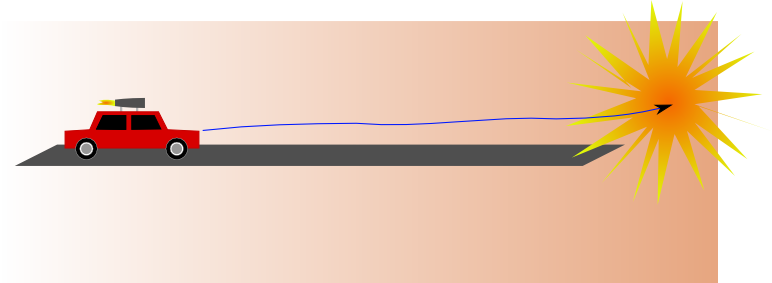
It's that time again: Mythbusters is back! And they sure know how to kick things off with a bang — or better yet, a prolonged burn!
For the 10th anniversary of the show, the Mythbusters revisited the very first myth they ever tested, the JATO rocket car. Wikipedia has the story in what appears to be its most common form:
The Arizona Highway Patrol came upon a pile of smoldering metal embedded into the side of a cliff rising above the road at the apex of a curve. the wreckage resembled the site of an airplane crash, but it was a car. The type of car was unidentifiable at the scene. The lab finally figured out what it was and what had happened.
It seems that a guy had somehow gotten hold of a JATO unit (Jet Assisted Take Off - actually a solid fuel rocket) that is used to give heavy military transport planes an extra 'push' for taking off from short airfields. He had driven his Chevy Impala out into the desert and found a long, straight stretch of road. Then he attached the JATO unit to his car, jumped in, got up some speed and fired off the JATO!
The facts, as best could be determined, are that the operator of the 1967 Impala hit JATO ignition at a distance of approximately 3.0 miles from the crash site. This was established by the prominent scorched and melted asphalt at that location. The JATO, if operating properly, would have reached maximum thrust within five seconds, causing the Chevy to reach speeds well in excess of 350 MPH, continuing at full power for an additional 20-25 seconds. The driver, soon to be pilot, most likely would have experienced G-forces usually reserved for dog-fighting F-14 jocks under full afterburners, basically causing him to become insignificant for the remainder of the event. However, the automobile remained on the straight highway for about 2.5 miles (15-20 seconds) before the driver applied and completely melted the brakes, blowing the tires and leaving thick rubber marks on the road surface, then becoming airborne for an additional 1.4 miles and impacting the cliff face at a height of 125 feet, leaving a blackened crater 3 feet deep in the rock.
Most of the driver's remains were not recoverable; however, small fragments of bone, teeth and hair were extracted from the crater, and fingernail and bone shards were removed from a piece of debris believed to be a portion of the steering wheel.

It's a fascinating story and all, but there's plenty of evidence to suggest that this didn't happen, and in fact that it can't happen as described. Not only does the Arizona Highway Patrol have no record of ever investigating a case like this, but it's been tested no less than three times on Mythbusters.
, though it did exceed the
top speed of the chase helicopter.
. In this iteration, the Mythbusters also tested the part of the myth in which the car supposedly took off and flew through the air — which also failed spectacularly (in every sense of the word), with their test car running off a ramp and nosediving into the desert.There's a lot of juicy physics in this myth. But it breaks down into a couple of key parts: first, can a rocket-powered Impala even make it up to
? And secondly, if it did, could it fly a mile and a half through the air? I'm going to handle the speed issue here, and get into the fable of the flying car for a later post.

Before it becomes airborne, a JATO car is just an object subject to three forces: the thrust of the rocket and the engine force pointing forward, and air resistance pointing backward. Well, there's also tire friction, but that's a lesser influence. In the simplified model I'm going to use, three of these forces are constant — the thrust and engine force forward, and tire friction backward — and air resistance is the one velocity-dependent force. For convenience I'll group all the constant forces under the name drive force,
.
With the forces as described, a car is pretty similar to a falling object, which is also subject to a constant force in one direction and air resistance in the other. Like, say, an airplane pilot who fell out of his plane at
, which I've already worked through the math for in an earlier blog post. Here's how that same math applies to the JATO car: first write Newton's second law
, including the drive force
and the air resistance
,

The car's terminal speed is the speed at which its acceleration,
, is zero. Plugging that in, we get

Now we can rewrite Newton's second law like so:

This makes it easy to see that if an object is moving faster than its terminal speed at any point, that is
, it will tend to slow down (because
), and if it's moving slower than its terminal speed,
, it will speed up. It'll only stay at a steady speed if
, and that requires
, i.e. that the object is traveling roughly at its terminal speed.
The story from Wikipedia has the car barreling down the road at more than
for several seconds, which suggests that for a JATO Impala,
. Is that realistic? Well, we do have some of the information necessary to figure it out. As reported in the Mythbusters pilot, the thrust of a JATO is about
, or
, and the density of air,
. But we don't know the cross-sectional area
and drag coefficient
of the car.
Hmm. That could be a problem.
Fortunately, there's a way around that. Ever heard of a drag race? That's where you set a car (or two) at the beginning of typically a quarter mile track and just floor it to see how fast it makes it to the end. Besides being good for a movie or two... or six (come on, seriously?), the quarter-mile run is a pretty common way to test a car's performance, and the results of some of these drag tests are available online. For the '67 Impala, the site gives
1967 Chevrolet Impala SS427 (CL)
427ci/385hp, 3spd auto, 3.07, 0-60 - 8.4, 1/4 mile - 15.75 @ 86.5mph
This means the car's acceleration is sufficient to take it from rest to
in
, and that it completed the quarter mile in
, traveling
over the final 66 feet.

Let's now go back to the rewritten version of Newton's second law for a normal car,

You can solve this by rearranging and integrating it, but I'm lazy: I just plugged it into Mathematica. The solution for speed as a function of time is

where
is the initial speed. Now, a '67 Impala has a mass of
(it varies from car to car, of course, but that's a representative value), and in a drag test, the initial velocity
. That leaves two variables still unknown:
, the net forward force which moves the car (engine minus friction), and
, its terminal velocity. Luckily, we have two data points we can use to solve for them: the 0-60 benchmark
, and the quarter mile time
. Those two velocity-time coordinates should be enough to determine
and
. Probably the easiest way to do it is to make a contour plot showing the combinations of
and
that satisfy each condition, like this:

The blue curve shows the points at which

and the red curve shows points where

Their intersection is the one set of parameters that satisfies both conditions, namely
and
. Bingo! Now we've got everything we need to calculate the behavior of the rocket car.
Well, wait a minute. We said — actually, Mythbusters said (and what I can find online seems to confirm) that a JATO provides a thousand pounds of thrust. But the value we found for
is even larger. Surely a standard car engine can't be more powerful than a rocket, can it?
I think we have to conclude that it is. Though this isn't quite what you'd call a standard car engine. The results of the drag test we used to calculate
were for the '67 Impala SS (Super Sport) 427, a special high-performance version of the car whose engine could crank out
. A standard version of the car would have a less powerful engine, ranging down to
, and thus could have as little as half the engine force — roughly,
, because
and
, and
.
Note that if you use
as obtained from the drag test to calculate the power at the car's top speed of
, you get
, which is quite close to the engine's reported horsepower. But I think that's just a coincidence. The same method applied to the car's eventual top speed of $SI{100.8}{mph} gives
, which is more power than the engine is even able to generate! This reflects the fact that the way we derived
makes a lot of simplifying assumptions. For example, it assumes that the air resistance is proportional to
. In reality, a car is a complicated shape that induces some amount of turbulence, making the drag force difficult to characterize. More importantly, we've assumed the drive force is constant, which is not at all true for a real car. The engine force changes as the car shifts gears and as parts warm up, there are other assorted forces at work like rolling friction.
As a check of sorts on how close this model comes, I'm going to integrate the formula again, to get a formula for distance traveled over time:

In theory, we should be able to plug in the values we found —
,
, and
— along with the quarter mile time,
, and the distance
will pop out. When I actually plug the values in, I get
, which is within 10%, so not bad. That suggests that the different inaccuracies cancel out to some extent.
OK, so where does that leave us? We have a formula,

which seems to somewhat accurately describe the motion of a car under its own power in a drag test. We also have best-fit values for the parameters of this formula:
, and
for the SS427, and
for a standard Impala. Time to ramp it up to the JATO rocket car!
You may remember from earlier in this post that the terminal velocity is proportional to the square root of the net constant force
applied to move the car. If a terminal speed of
corresponds to a drive force of
, then adding on a JATO's thrust of an additional
would naively give a terminal speed of

Doing the same calculation for the
hobby rockets the Mythbusters used gives

which is considerably less than the estimate of a top speed around
for the car in the pilot episode. Huh.
OK, so what could be wrong with the model?
— of the car (with attached rocket) be much smaller than we thought, making the car's terminal speed higher? It's hard to see how. After all, the terminal speed we calculated was for a stock Impala, a shape which is reasonably aerodynamic, but the Mythbusters went and put a rocket pack on it, breaking the airflow over the roof. If anything, it should go slower with the rockets on top.
by increasing engine force would require an engine almost three times as strong as what I'm using in the model.I'm actually doubtful that whatever the error is has anything to do with the car itself. Here's why: suppose we take that equation for
from earlier and plot it, starting at
, for several different configurations.

The lower edge of each band represents a car with a standard
motor, and the higher edge represents a car with an enhanced performance
motor. And the shaded areas represent the results we actually saw on Mythbusters (or the circumstances described in the myth, for the gray box). Notice that the orange band, representing the car with 5 rockets simultaneously firing as in the anniversary special, goes right through the pink box representing the speed we saw on that show. So the model works in that case!
On the other hand, the light green band, the one for the hobby rockets used in the pilot, only barely breaks the
speed of the chase helicopter (the dotted line) and doesn't ever get up to the speed estimate of
. The only way I can come up with to reconcile this math with the results we saw on the show is that the rockets they used might have been more powerful than claimed. If you assume that the rockets give off a little more than twice as much thrust as was said on the show, i.e. around
, you get the dark green curve which seems to come close to the observed results. If anyone knows a better explanation for that difference, I'd be interested to here it, but for now I just have to conclude that something was off about those reported rocket numbers.
Of course, let's not forget the real point of the graph. None of these curves come anywhere close to the circumstances claimed in the myth! So despite the discrepancies in the details, the conclusion remains solidly the same: physics says this myth is absolutely busted.
Last week, I wrote about the announcement of the first results from the Alpha Magnetic Spectrometer: a measurement of the positron fraction in cosmic rays. Although AMS-02 wasn't the first to make this measurement, it was nevertheless a fairly exciting announcement because they confirm a drastic deviation from the theoretical prediction based on known astrophysical sources.
Unfortunately, most of what you can read about it is pretty light on details. News articles and blog posts alike tend to go (1) Here's what AMS measured, (2) DARK MATTER!!!1!1!! All the attention has been focused on the experimental results and the vague possibility that it could have come from dark matter, but there's precious little real discussion of the underlying theories. What's a poor theoretical physics enthusiast to do?
Well, we're in luck, because on Friday I attended a very detailed presentation on the AMS results by Stephane Coutu, author of the APS Viewpoint about the announcement. He was kind enough to point me to some references on the topic, and even to share his plots comparing the theoretical models to AMS (and other) data, several of which appear below. I never would have been able to put this together without his help, so thanks Stephane!
Time to talk positrons.
When people talk about "known astrophysical sources" of positrons, they're mostly talking about cosmic rays. Not primary cosmic rays, though, which are the particles that come directly from pulsars, accretion discs, or whatever other sources are out there. Primary cosmic rays are generally protons or atomic nuclei. As they travel through space, they decay into other particles, secondary cosmic rays, through processes like this:

Positrons in the energy range AMS can detect, below
or so, mostly come from galactic primary cosmic rays (protons). We can determine the production spectrum of these cosmic ray protons (how quickly they are produced at various energies) using astronomical measurements like the ratio of boron to carbon nuclei and the detected flux of electrons — but that's a whole other project that I won't get into here.
Once the proton spectrum is set, we can combine it with the density of the interstellar medium to determine how often reactions like the one above will occur, again as a function of energy. That gives us a spectrum for positron production. But to actually match this model to what we detect in Earth orbit, we need to account for various energy loss mechanisms that affect cosmic rays as they travel. Both primary (protons) and secondary (positrons) cosmic rays lose energy to processes like synchrotron radiation (energy losses as charged particles change direction in a magnetic field), bremsstrahlung (energy losses from charged particles slowing down in other particles' electric field), and inverse Compton scattering (charged particles "bouncing" off photons). These dissipative mechanisms tend to reduce the positron spectrum at high energies.
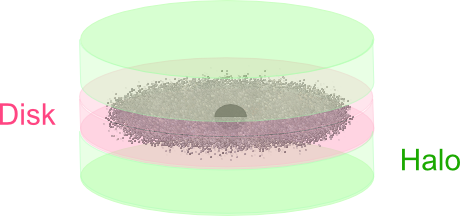
Doing all this accurately involves accounting for the distribution of matter in the galactic disk, and accordingly it takes a rather sophisticated computer program to get it right. The "industry standard" is a program called GALPROP, which breaks down the galaxy and its halo (a slightly larger region surrounding the disk, which contains globular clusters and dark matter) into small regions, tracks the spectra of various kinds of particles in each region, and models how the spectra change over time as cosmic rays move from one region to another. There are various models with different levels of detail, most of which are described in this paper and improved in e.g. this one and this one:
(or
).
.There are others, less commonly used, but all these models share one significant thing in common: they give a positron fraction that decreases with increasing energy. And the first really precise measurements of cosmic ray positrons, performed by the HEAT and CAPRICE experiments, confirmed that conclusion, as shown in this plot.
But new data from PAMELA, Fermi-LAT, and now AMS-02 show something entirely different! Above
, the positron fraction actually increases with energy, showing that something must be producing additional positrons at those higher energies.
The spectrum of the positron fraction excess, i.e. the difference between secondary emission predictions and the data, suggest that this unknown source produces roughly equal numbers of positrons and electrons at the energies AMS has been able to measure, with a power-law spectrum for each:

As an example model, the AMS-02 paper postulated

with
based on a fit to their data. But regardless of whether this specific formula works, the point is that secondary emission tends to produce more positrons than electrons (because most primary cosmic rays are protons, which generally decay into positrons due to charge conservation). That doesn't fit the profile. This unexplained excess is probably something else.
Naturally, physicists are going to be most excited if the positron excess turns out to come from some previously unknown particle. The most likely candidate is the neutralino, denoted
, a type of particle predicted by most supersymmetric theories. Neutralinos are the superpartners of the W and Z gauge bosons, and of the Higgs boson(s).
According to the theories, reactions involving supersymmetric particles tend to produce other supersymmetric particles. The neutralino, as the lightest of these particles , is at the end of the supersymmetric decay chain, which makes it a good candidate to constitute the mysterious dark matter. But occasionally, neutralinos will annihilate to produce normal particles like positrons and electrons. If dark matter is actually made of large clouds of neutralinos, it's natural to wonder whether the positrons produced from their annihilation could make up the difference between the prediction from secondary cosmic rays and the AMS observations.
Here's how the calculation goes. Using the mass of dark matter we know to exist from galaxy rotation curves and gravitational lensing, and assuming some particular mass
for the neutralino, we can calculate how many neutralinos are in our galaxy's dark matter halo. Multiplying that by the decay rate predicted by the supersymmetric theory gives the rate of positron production from neutralino decay. That rate gets plugged into cosmic ray propagation models like those described in the last section, leading to predictions for the positron flux measured on Earth.
Several teams have run through the calculations and found that... well, it kind of works, but only if you fudge the numbers a bit. Neutralino annihilation predicts a roughly power-law contribution to the positron fraction up to the mass of the neutralino; that is,

As long as
or so, this is exactly the kind of spectrum needed to explain the discrepancy between the PAMELA/Fermi/AMS results and the secondary emission spectrum. The problem lies in the overall constant
, which you would calculate from the dark matter density and the theoretical decay rate. It's orders of magnitude too small. So the papers multiply this by an additional "boost" factor,
, and examine how large
needs to be to match the experimental results. Depending on the model,
ranges from about 30 (Baltz et al.,
) to over 7000 (Cholis et al.,
).
Alternatively, you can assume that something is wrong with the propagation models, and that positrons lose more energy than expected on their way through the interstellar medium. This is the approach taken in this paper, which finds that increasing the energy loss rate by a factor of 5 can kind of match the positron fraction data.
But that much of an adjustment to the energy loss leads to conflicts with other measurements. It winds up being an even more unrealistic model.
Even if the parameters of some supersymmetric theory can be tweaked to match the data without a boost factor, there's one more problem: neutralinos decay into antiprotons and photons too. If the positron excess is caused by neutralino decay, there should be corresponding excesses of antiprotons and gamma rays, but we don't see those. It's going to be quite tricky to tune a dark matter model so that it gives us the needed flux of positrons without overshooting the measurements of other particles. There is only a small range of values of mass and interaction strength that would be consistent with all the measurements. So as much as dark matter looks like an interesting direction for future research, it's not a realistic model for the positron excess just yet.
With the dark matter explanation looking only moderately plausible at best, let's turn to other (less exotic) astrophysical sources. There's a fair amount of uncertainty about just how many cosmic rays are produced even by known sources. They could be emitting enough electrons and positrons to make the difference between the new data and the theories.
Pulsars in particular, in addition to being sources of primary cosmic rays (protons), are often surrounded by nebulae that emit electrons and positrons from their outer regions. The pulsar's solar wind interacts with the nebula to accelerate light particles to high energies, giving these systems the name of pulsar wind nebulae (PWNs). Simply by virtue of being a PWN, it's expected to emit a certain "baseline" positron and electron flux, which is included in secondary emission models, but the pulsar could have been much more active in the past, emitting a lot more positrons and electrons. These would have become "trapped" in the surrounding nebula and continued to leak out over time, which means we would be seeing more positrons and electrons than we'd expect to based on the pulsar's current activity. There are a few nearby PWNs which seem like excellent candidates for this effect, going by the (rather snazzy, if you ask me) names of Geminga and Monogem. A number of papers (Yüskel et al., and recently Linden and Profumo) have crunched the numbers on these pulsars, and they find that the positron/electron flux from enhanced pulsar activity can match up quite well with the positron fraction excess detected by PAMELA, Fermi-LAT, and AMS-02.
The "smoking gun" that would definitely (well, almost definitely) identify a pulsar as the source of the excess would be an anisotropy in the flux: we'd see more positrons coming from the direction of the pulsar than from other directions in the sky. Now, AMS-02 (and Fermi-LAT before it) looked for an effect of this sort, and they didn't find it — but according to Linden and Profumo, it's entirely possible that the anisotropy could be very slight, less than what either experiment was able to detect. We'll have to wait for future experimental results to check that hypothesis.
Of course, it's important to remember (again) that all these analyses are based on the propagation models that tell us how cosmic rays are produced and move through the galaxy. It's entirely possible that adjusting the propagation models alone, without involving any extra source of positrons, would bring the predictions from secondary emission in line with the experimental data.
A paper by Burch and Cowsik looked at this possibility, and it turns out that something called the nested leaky-box model can fix the positron fraction discrepancy fairly well. As I wrote back in the first section, the leaky box model gets its name because cosmic rays are considered to be partially confined within the galaxy. Well, the nested leaky box model adds the assumption that cosmic rays are also partially confined in small regions around the sources that produce them. That means that, rather than being produced uniformly throughout the galaxy, secondary cosmic rays come preferentially from certain regions of space. This is actually similar to the hypothesis from the last section, of extra positrons coming from PWNs, so it shouldn't be too surprising that using the nested leaky box model can account for the data about as well as the pulsars can.
All the media outlets reporting on the AMS results have been talking about the dark matter hypothesis, even going so far as to say AMS found evidence of dark matter — but clearly, that's not the case. There's no reason to say we have evidence of dark matter when there are perfectly valid, simpler, maybe even better explanations for the positron fraction excess at high energies! There's just not enough data yet to tell which explanation is right.
As AMS-02 continues to make measurements over the next decade or so, there are two main things to look for that will help distinguish between these models. First, does the positron fraction stop rising? And if so, where on the energy spectrum does it peak? As we've seen, this can happen in any model, but if neutralino annihilation is the right explanation, that peak will have to occur at an energy compatible with other constraints on the neutralino mass. Perhaps more importantly, is there any anisotropy in the direction from which these positrons are coming? If there is, it would pretty strongly disfavor the dark matter hypothesis. The anisotropy itself could actually point us toward the source of the extra positrons. So even if we don't wind up discovering a new particle from this series of experiments, there's probably something pretty interesting to be found.
A fair amount of what I write about here is about accelerator physics, done at facilities like the Large Hadron Collider. But you can also do particle physics in space, which is filled with fast-moving particles from natural sources. "All" you need to do is build a particle detector, analogous to ATLAS or CMS, and put it in Earth orbit. That's exactly what the Alpha Magnetic Spectrometer (AMS) is. Since 2011, when it was installed on the International Space Station, AMS has been detecting cosmic electrons and positrons, looking for anomalous patterns, and today they presented their first data release.
Let's jump straight to the results:
This plot shows the number of positrons with a given energy as a fraction of the total number of electrons and positrons with that energy,
. The key interesting feature, which confirms a result from the previous experiments PAMELA and Fermi-LAT, is that the plot rises at energies higher than about
. That's not what you'd normally expect, because most physical processes produce fewer particles at higher energies. (Think about it: it's less likely that you'll accumulate a lot of energy in one particle.) So there must be some process, not completely understood, which is producing positrons.
As part of their data analysis, AMS has tested a model which describes the flux (total number) of positrons as the sum of two contributions:

The model fits pretty well to the data so far:
This means that the AMS data are consistent with the existence of a new massive particle, one that might make up the universe's dark matter. But a new particle is not the only explanation. You'll see a lot of news articles, blog posts, comments, etc. saying that AMS has detected evidence of dark matter, but that's just not true. For example, there are known astrophysical sources, such as pulsars, which could conceivably be making these high-energy positrons. The results found by AMS so far are not precise enough, and don't go up to high enough energies, to allow us to tell the difference with any confidence.
There are a couple of signs we'll be looking for that could help identify this unknown source of positrons:
AMS will continue to collect data for a long time to come, so we can look forward to ever more precise data releases in the future, data which will hopefully put a rest to the mystery of the not-missing positrons. In the meantime, you may want to check out the PRL viewpoint — a not-too-technical explanation — of this research, or even read the original paper, which can be downloaded for free from the gray citation on the viewpoint page.
Oh, I kid. Despite the name, nothing about this post is a prank (except perhaps for the title).
It's been a week and a half since the Planck collaboration released their measurements of the cosmic microwave background. At the time, I wrote about some of the many other places you can read about what those measurements mean for cosmology and particle physics. But it's a little harder to find information on how we come to those conclusions. So I thought I'd dig into the science behind the cosmic microwave background: how we measure it and how we manipulate those measurements to come up with numbers.
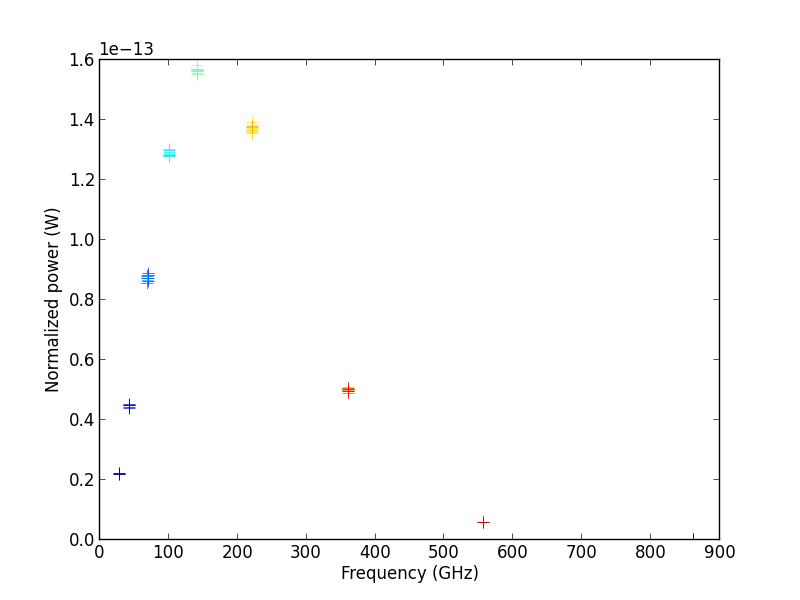
With that in mind, what did Planck actually measure? Well, the satellite is basically a spectrometer attached to a telescope. It has 74 individual detectors, each of which detects photons in one of 9 separate frequency ranges. As the telescope points in a certain direction, each detector records how much energy carried by photons in its frequency range hit it from that direction. The data collected would look something like the points in this plot:

From any one of these data points, given the frequency and the measured power, you can calculate the temperature of the blackbody that produced it by starting with Planck's law,

(
is the frequency), combining it with the definition of spectral radiance,

(
is the area of the satellite's mirror,
is the solid angle it sees at one time), and solving for temperature to get

With 74 separate simultaneous measurements, you can imagine that Planck is able to constrain the temperature of the CMB very precisely!
We've known for quite some time, since the COBE data presentation in 1990, that the CMB has an essentially perfect blackbody spectrum, with a temperature of
.

But we've also known for some time that the CMB isn't exactly the same temperature in every direction. It varies by tiny fractions (thousandths) of a degree from one spot in the sky to another, so depending on which way you point the telescope, you'll find a slightly different result. The objective of the Planck mission, like WMAP before it, is to measure these slight variations in temperature as precisely as possible.
One way to represent the temperature variations, or anisotropies, measured by Planck is a straightforward visualization, like this:
Every direction in space maps to a point in this image. Red areas indicate the directions in which Planck found the CMB to be slightly warmer than average (after accounting for radiation received from our galaxy and other known astronomical sources), and blue areas indicate the directions in which it was slightly cooler than average.
But for the scientific analysis of the CMB, it's not actually that important to know exactly where in the sky the hot spots and cold spots are. These little anisotropies were generated by quantum fluctuations in the structure of spacetime in the very early universe, and quantum fluctuations are random. No theory can actually predict that you'll have a hot spot in this particular direction and a cold spot in that particular direction. What you can predict is how the energy in the CMB should be distributed among various "modes." Each mode is basically a pattern of hot and cold spots of a characteristic size.
Modes are a lot easier to understand once you can visualize them, so let me explain the concept with a simple example. Here's a plot of a function:

Actually, that graph is kind of boring. Here's a more colorful way of visualizing the same function: a density map, which is red in the regions where the function is large and blue where it's small:

If you're familiar with Fourier analysis, you know that any function (more precisely: any periodic function on a finite interval of length
) can be expressed a sum of several sinusoidal functions with different wavelengths.

For this function, those are the 12 sine waves shown here:

Each of these sine waves corresponds to a mode. We typically label them by the number of peaks and valleys in the wave, shown as
on each plot. If you look at the density maps, you can see that the modes with higher numbers have smaller hot (red) and cold (blue) spots, as I mentioned earlier.
Having broken down the original function into these sine waves, you can talk about how much energy is in each mode. The energy is related to the square of the sine wave's amplitude. For example, the
mode of this function has the most energy;
and
have relatively little. You can tell because the graph of the
sine wave has the largest amplitude, and the
and
sine waves have small amplitudes. (The density maps don't show the amplitudes.)
What a cosmological theory predicts is the amount of energy (per unit time) in each mode: the numbers
. This is called the power spectrum.
We can do the same thing with the CMB that we did with the one-dimensional function in that example: break it down into individual modes, each with some amplitude, and determine how much energy is in each mode. Of course, the sky isn't a line; it's a sphere, which means the modes of the CMB are more complicated than just sine waves. Modes on a sphere are called spherical harmonics, and their density maps look like this:

Because a sphere is a two-dimensional surface, it takes two numbers to index these modes,
and
.
Any real-valued function on a sphere — like, say, the function which gives the temperature of the CMB in a given direction — can be expressed as a sum of real spherical harmonics, each scaled by some amplitude.

We can then go on to compute the power spectrum, just as in the 1D case. But it's conventional to combine the power in all the modes with the same value of
:

The numbers
constitute the power spectrum, analogous to
for the 1D function.
Here's the actual power spectrum measured by Planck, shown as red dots:
The quantity on the vertical axis is
. Beyond
or so, each point represents an average over a few different values of
. You don't see points for
or
on the plot because the amplitude of the
mode is just the average CMB temperature over the entire sky, which is probably skewed by sources of radiation local to our little corner of the universe, and the amplitude of the
mode is primarily due to our motion relative to the CMB. So the meaningful physics starts at
.
At this point, I would love to dig into the models, and explain where some of those features in the power spectrum come from. But that will have to wait for another day. Stay tuned for the sequel to this post, coming soon, where I'll talk about the physics that makes the CMB power spectrum what it is!
Yesterday, the team behind the European Space Agency's Planck satellite released their first set of data. This was a seriously exciting moment in the world of cosmology, in the same way as the previous weeks' Higgs updates were an exciting moment in the world of particle physics. And I have the perfect way to explain it to you:
Go read this, this, this, this, and this.
OK, seriously though. The preceding five blog posts do a fantastic job (individually, and even more so together) of explaining, at a reasonably abstract level why the Planck data release is important and what it means. Now, I do plan to do my usual act of digging into the science and explaining some of the details, but in this case, there's a lot of science. The Planck collaboration released thirty papers, and I just haven't had time to comb through them yet. So a proper Planck post will have to wait for some time later this weekend. Until then, you can get a good, just-technical-enough overview of results from Ethan Siegel's summary post, the last link in that last paragraph.
Sit back, close your eyes, and think all the way back to... last week, when physicists from the LHC experiments presented their latest results on the Higgs search at the Rencontres de Moriond Electroweak session. Yes, I know, we barely had time to digest those results. But digest we must, because this week there are even more new results coming out, from the Moriond session on QCD and High Energy Interactions. And what the experiments have presented today is, rightly or wrongly, turning a lot of heads.
The key update from today's presentations is a measurement by ATLAS of the cross section for the Higgs decaying to two W bosons, which each then decay to a lepton and a neutrino: the
channel. It comes on the heels of a similar measurement presented by CMS last week. Both detectors are now reporting that they measure a strong signal for
detection beyond the standard model (without a Higgs boson) at
, with a significance of
at CMS and
at ATLAS. In other words, if the particles of the standard model, not including the newly discovered Higgs candidate, were all the particles there are, the probability that each detector would measure what it did is less than a hundredth of a percent.
Compared to the last batch of Higgs search results, when ATLAS was only detecting a
signal and CMS a
signal, this is a significant improvement indeed. (Pun intended, if you got it!) As far as I know, nobody has combined the new results from ATLAS and CMS to see just what statistical significance they get when put together, but if they did, it would likely be above the "mythical"
threshold in this channel alone. Plainly put, that means we are now effectively certain the newly discovered particle decays to W bosons.
OK, so why is that so important? Well, the whole reason the Higgs boson was predicted was to allow the W and Z bosons, the carriers of the weak force, to have mass. It does so via the Higgs mechanism, which also predicts that the Higgs boson should interact with those bosons. If this newly discovered particle didn't interact with the W, it couldn't be the Higgs! Simple as that. But now, we know that if that were the case, it would be extremely unlikely that ATLAS and CMS would be seeing the results that they are. So that's probably not what's happening.
However, just discovering that the new particle interacts with W bosons doesn't automatically mean that it is the standard model Higgs. There are plenty of theories that predict Higgs bosons, any one of which (or none of which) could be correct. It'll take many more years of data collection and analysis before we can rule out all but one of the proposed theories.
I leave you with this animation of the signal appearing in the
channel at ATLAS, showing how it differs from the expectation based on a standard model without the Higgs, and how including a standard model Higgs boson with a mass of
very neatly fills in the gap.

This week sees a major physics conference in Italy, the Rencontres de Moriond 2013 Electroweak session. It's notable because the LHC experimentalists involved in the search for the Higgs boson are presenting their latest results. (There are also many other things being presented — less high-profile, but no less important!) I won't give too many details of what has been presented, since there are plenty of other places on the web you can read about it, but certainly a quick overview is in order.
When last we left the Higgs search, it was November, and the experimentalists had just presented the results of analyzing the data the LHC had collected in the later half of summer 2012, combined in some cases with earlier data.
Of the various ways (channels) the standard model Higgs boson can decay, the experiments are looking most closely at these five:
(two photons)
(two leptons and two neutrinos)
(four leptons)
(two tau leptons)
(bottom and antibottom quark)Remember that if the particle discovered is really the standard model Higgs boson, it should decay via each of these channels exactly as often as predicted. As of last November, there were some hints that it might not be doing that: ATLAS and CMS had seen slightly more diphoton decays than predicted, and slightly fewer tau and bottom decays than predicted. It wasn't conclusive evidence of anything, but physicists were holding out a little bit of hope that these slight discrepancies would become stronger as more data was collected, and would indicate something new to be discovered.
Unfortunately, with the new results presented yesterday, it looks more and more likely that the particle we've discovered is the plain old standard model Higgs boson, with no surprises. Both ATLAS and CMS are starting to release plots which show the number of observed events in a given channel compared to what is expected from the standard model with a Higgs boson with a mass of
, and they match quite closely. For example, here are the plots from CMS [PDF] showing the numbers of
pairs detected,

and the numbers of
pairs detected,

In both cases, you can see that the lines for the observed counts are coming out above the green and yellow bands showing what would be expected if there were no Higgs boson, and are getting closer to the red lines showing what is expected with a
Higgs. There is still some excess in the
channel above
, but that may well be a statistical fluke and has a decent chance of disappearing with time.
ATLAS is still seeing some more collisions than expected in the diphoton channel, but again, it's not enough to strongly indicate that something unexpected is happening.
In addition to just looking at the different decay channels, physicists are also checking the spin and parity of the new particle, to check whether it matches the expectation for the standard model Higgs boson: zero spin and even parity. Back in November, that set of properties seemed most likely, but it wasn't anywhere near conclusive. This week, both LHC experiments released more detailed analyses of the different possibilities for spin and parity the new particle could have. Here are some plots from CMS, for example:

Each graph shows a comparison of the standard model Higgs hypothesis, spin zero and even (+) parity (yellow), with another hypothesis (blue). The way to read these is to look at the height of each curve at the position of the red arrow. If one curve is much higher than the other, then one hypothesis is correspondingly much more likely than the other. You can see this in the center column, for example, where the height of the blue curve at the position of the arrow is essentially zero. That means that it's exceedingly unlikely the new boson has spin one. (We know that it can't have spin one if it's a single particle, because it decays into two photons which each have spin one themselves, but if there are multiple particles with the same mass, it's possible one of them has spin one, which is what those center graphs are exploring.) In some of the other plots, it's clearly more likely that the new boson has spin zero and even parity, but not likely enough to eliminate the possibility outright. Quantitatively, all hypotheses other than
are excluded at a
level, which is short of the
exclusion that physicists would like to consider the matter closed.
New results aren't the only things to come out of this conference, though. ATLAS has release some excellent animated GIFs showing how peaks emerge in the diphoton and four-lepton channels as you accumulate data over time. It's rare to see a really good use of animation, and it's also disappointingly rare to see a truly effective way of visualizing any scientific data, so this is a real treat. Observe and enjoy!
Just a quick note that the LHC stopped operation this past week and has gone into its first long shutdown. This shutdown period lasts two years, and during that time the accelerator will be upgraded to allow it to run at its full design energy of
per beam for proton-proton collisions.
You can always track the status of the accelerator complex using LHC Page 1 or the LHC Dashboard, although they're not going to have anything interesting for a while.
In the meantime, theorists and much of the LHC experimental collaboration members are going to have their hands busy analyzing the data that came out of this first run. Of course there is the ongoing search for the Higgs boson, which is by now actually a search to determine whether the boson that was discovered is in fact the standard model Higgs. But there are all sorts of other predictions to be checked, most of which have to do with pinning down the behavior of known particles under extreme conditions, rather than discovering any new particles. The LHC ran three different types of collisions: proton-proton, proton-lead, and lead-lead, and some of the most interesting results (in my highly biased opinion) will come from comparing the distributions of particles produced during these different kinds of collisions. Stay tuned!
If you care at all about (American) football, or are trying to pretend you do, you probably saw the power go out during the Superbowl this past Sunday. Half the stadium lights, the scoreboard, and the announcers' booth, completely out of commission. Hey, did you know there are actually people talking during the game most of the time?
Anyway, one of my friends made an offhand comment about people holding their phones up like candles, but it got me thinking, XKCD-style: what kind of light could you get on a football field from cell phones? Enough to play? Or would you have to give everyone xenon lamps? To find out, we have to delve into the, um, murky world of photometry, the science of measuring the perception of light.
Let's start with something simple. Anyone who's familiar with a bit of physics knows about power: the amount of energy per unit time. When you characterize a light bulb as a hundred-watt bulb, for instance, that's a measure of the power it puts out when attached to the circuitry of a standard lamp. There's a whole hierarchy of other measurements you can make that are all derived from power: the power per unit area, power per unit solid angle, power per unit wavelength, and so on.
But power doesn't tell the whole story. In order to light a football game, what you need is not a particular amount of power, but an amount of perceived brightness, which is not the same thing. They're different because the eye doesn't respond to all wavelengths equally. We normally have the strongest response in the green part of the spectrum, which means that a given power of green light will appear brighter than the same power of red light, or blue light. For example, a green milliwatt laser will look brighter than a red milliwatt laser (in the instant before they destroy your retina), even though they both have the same power. As a more extreme example, incandescent light bulbs emit a lot of their energy in infrared radiation, which the eye doesn't respond to at all. Even though a bulb might use a hundred watts of power, it produces a level of brightness that only takes about 5 of those watts to create. This is why fluorescent bulbs are so efficient: they match the brightness of an incandescent bulb by giving off similar amounts of power in the visible spectrum, without all the wasted infrared radiation. If you wanted even more efficient lighting, you could use green fluorescent bulbs. (A key step in turning your home into an evil lair.)
Photometry uses its own hierarchy of measurements:
, which is the total effect of all the light emitted from all parts of an object in all directions. It's measured in lumens. You can characterize the lighting ability of a light bulb, for instance, by its luminous flux. (Look on the package, you'll find a number of lumens printed there.)
, measured in candelas (lumens per steradian). Luminous intensity reflects the object's actual perceived brightness as you're looking at it from a particular direction.
, if it's the flux per unit area of the object being illuminated, or luminous emittance,
, if it's the flux per unit area of the emitter. In either case, the unit is the lux, a lumen per square meter. Luminous emittance characterizes the ability of, say, an array of bulbs to emit light; obviously the larger you make the array, the more light it will emit, but the luminous emittance normalizes that by dividing by the area. And illuminance is what determines your eye's ability to see something: it has to exceed the amount of luminous flux needed to stimulate a cell on your retina divided by the area occupied by that cell.
. This is measured in candelas per square meter, also known as nits. (There's no shortage of funny non-SI unit names in this business.) Luminance represents the perceived brightness of a bright object per unit area. Because luminance normalizes for both surface area and solid angle, it's the quantity of choice to measure the perceived brightness of a computer display or cell phone screen from a particular direction.
OK, so what are some typical values for the luminance of a phone display? The very popular iPhone 5 gets 562 cd/m^2. But it's a hypothetical situation, so let's go all out: the brightest actual cell phone screen I could find evidence for is the Nokia 701, at 1000 cd/m^2.
To compare the stats for a phone to the required lighting on the field, we'll need to calculate the illuminance a single cell phone produces on the field. Illuminance is luminance times solid angle, so we integrate the luminance of the cell phone's screen over its angular size as seen from the field:

can be considered constant over the phone's screen, and if the screen is pointed right at the field from above,
, so this is just a multiplication. And solid angle is equal to area divided by the distance between the phone and the field squared, so

Now we get to add this up for one phone for each person at the Superbowl. All 71024 of them. That's a lot of phones.
As you might guess, getting an exact answer would be pretty complicated, but maybe we can get away with a "physicist's shortcut:" let
be the distance of the closest seat to the center of the field (front row, 50-yard line). Based on the standard dimensions of an NFL field
should be a little over
, but I'll underestimate and use that actual value. Suppose every one of those 71024 phones was at that distance. With
per phone,
(source), the total illuminance is
![E_{V,\text{max}} = 71024\frac{\SI[per-mode=fraction]{1000}{\candela\per\square\meter}\times \SI{34}{cm^2}}{(\SI{106}{ft.})^2} = \SI{230}{lx}](/images/latex/9ece58e3694aae760f0f31c6de1fea6f.png)
I couldn't find any data on lighting levels recommended by the NFL, but for the NCAA football championship, the recommended lighting level is 125 foot-candles [PDF], which is equal to
, to the camera at the 50-yard line. Even if all 71024 cell phones were pointed directly into the camera, straight on, they wouldn't produce enough light to meet that threshold. Not even close. So replacing the normal Superbowl lights with a sea of cell phones is not going to work.
In the spirit of XKCD and Mythbusters, what would it take? Well, we've already calculated
, and it's proportional to both the luminance and the phone area. So as a minimum baseline, we need a phone that's either six times bigger or six times brighter. Maybe a tablet? The Panasonic Toughpad FZ-G1 has a 10.1-inch screen, with an area of
, and a luminance of
.
![E_{V,\text{max}} = 71024\frac{\SI[per-mode=fraction]{800}{\candela\per\square\meter}\times \SI{315}{cm^2}}{(\SI{106}{ft.})^2} = \SI{1715}{lx}](/images/latex/483801ecc4ee5951c73fcca1df592b4e.png)
Now we're talking. So stadium designers, listen up: just spend the $205 million to slip a Toughpad under every seat in case of power outage, and you'll be fine.
Except not really.
, after all, is not the actual illuminance that will be delivered to a TV camera, first, we're still using an extremal model where all the phones (or tablets) are right at the edge of the field. Also, the numbers I've been calculating are for a surface receiving light directly from the phones — they only apply if every phone is pointed directly into the camera. In reality, the cameras pick up the reflection off the field, the football, the players, or whatever else they're pointed at, so we'll need to include a factor to account for that.
First, I'm going to come up with a more accurate estimate of the light delivered by phone screens which are actually placed in the stadium seats. The obvious way to do this would be to add up the contributions from the seats by row, but that's not so easy because the seats in a row aren't all at the same distance from the field, plus there are partial rows, plus there aren't even the same number of seats in each row. If you had access to an exact blueprint of the seating area of the Super Dome, you could crunch the numbers, but I don't, and besides, that would be excruciatingly complicated.
Instead, I'll construct a toy model of the stadium's layout, and assume the seats are continuously distributed throughout the seating area of this model. The model is going to look like this:
| Angle view | Top view |
|---|---|
![]() |
![]() |
It's basically a circular seating region with diameter
, with a rectangle of
cut out of the middle for the field. It doesn't take into account that the stadium has three tiers of seating that partially overlap, or that the seating region is actually slightly elliptical, but I think this should be good enough as a first approximation.
The first thing I'm going to need is the average area per seat — or rather, the average seating area per person.

Armed with that number, I can calculate the total illuminance at the center of the field like this:

I'm integrating the illuminance per phone, including the cosine factor which accounts for the phone's light coming in at an angle, over the seating area, and then dividing by the area per seat as a normalizing factor. This is really just a weighted average of the illuminance, where the weight is the number of seats (area covered divided by area per seat). Calculating weighted averages in this way, by using some auxiliary quantity (in this case area), is pretty common in physics.
The next thing I'll need is the height of a given seat above the ground. This is specified by the model: I've constructed it so that the seat heights are given by a (relatively) simple formula,
![z = \SI{0.001074}{ft.^{-1}}\bigl[\max\bigl(x^2 - (\SI{106}{ft.})^2, 0\bigr) + \max\bigl(y^2 - (\SI{192}{ft.})^2, 0\bigr)\bigr]](/images/latex/5d4299299f0448928a7fc677f3bbf33b.png)
The leading coefficient of
is chosen to be consistent with a central dome height of
(source), given that the dome spans a 90 degree arc. (Optional exercise for the reader: derive that.)
This integral is too complicated to be done symbolically, of course, but it's not hard with a numerical algorithm, and the result is

Nice and simple. It even doesn't have any units to worry about! Plugging this and the other numbers into the formula for illuminance, we get

Let's see where we've gotten: plugging in the numbers for the Nokia 701 gives a paltry 9 lux! Remember, though, this is the illuminance received by the field and objects on it, not by the camera. We still have to account for how the light is attenuated and redistributed by reflection.
There are two effects to account for here. First, any material reflects only a fraction of the light it receives, given by a quantity called the albedo. Technically albedo is defined in terms of reflected and incident energy, whereas we're using perceived brightness, but we can use the same values as a decent first approximation. Most of what the camera will be seeing is artificial turf, and the albedo of artificial turf is typically 5-10%.
Besides the drop in brightness caused by the reflection, we also have to account for the fact that not all the incoming light is reflected in the direction of the camera. As a model, I'll take the turf to be a Lambertian reflector, which basically means that it reflects incoming light with equal luminance in all (upward) directions. Now, we already know that
. If the luminance
is equal in every direction, we can pull it out of the integral and find that, for a Lambertian reflector,

So, putting it all together, the luminance received by the field will be
times the illuminance it receives from the 71024 phones, which we've already calculated. Then the luminance reflected will be 5% of that. (I'm choosing a low value to offset the fact that this calculation is for the center of the field, the brightest part.) That luminance gets transmitted unchanged to the camera, where we integrate
over the camera's field of view to get the illuminance delivered to the camera; this last integral brings in another factor which will be something less than
. Let's say it's a factor of 2. The final expression is

To hit
on the camera, we need
. For perspective, that's about what you'd get from focusing 1700 lumens, the light output of a typical 100W incandescent bulb, into a 20 degree cone using a parabolic reflector. It's also equivalent to the lower limit for a normal car headlight. So with a little over 35000 cars, you could illuminate the stadium, no external power needed!
If drive-in football ever becomes a thing, I totally called it.
I'm a sucker for good (or bad) physics puns. And the latest viral physics paper (arXiv preprint) allows endless opportunities for them. It's actually about a system with a negative temperature!
Negative temperature sounds pretty cool, but I have to admit, at first I didn't think this was that big of a deal to anyone except condensed matter physicists. Sure, it could pave the way for some neat technological applications, but that's far in the future. The idea of negative temperature itself is old news among physicists; in fact, this isn't even the first time negative temperatures have been produced in a lab. But maybe you're not a physicist. Maybe you've never heard about negative temperature. Well, you're in luck, because in this post I'm going to explain what negative temperature means and why this experiment is actually such a hot topic. ⌐■_■
To understand negative temperature, we have to go all the way back to the basics. What is temperature, anyway? Even if you're not entirely sure of the technical definition, you certainly know it by its feel. Temperature is what distinguishes a day you can walk around in a T-shirt from the day you have to bundle up in a coat. It makes the difference between refreshing lemonade and soothing tea. (If you drink your tea cold or your lemonade hot, I can't help you.) Temperature is the reason you don't put your hand in a fire. Basically, whatever temperature is, it has to allow you to tell things that feel hot apart from things that feel cold.
Now, if you think about some hot objects and some cold objects, like fire and ice, it might seem intuitive that hot things tend to have more energy than cold things. So you could define temperature as the average energy of an object. That definition actually works for the normal objects you interact with in your everyday life; it even works for a lot of less normal objects, like gases in extreme conditions. In fact in the kinetic theory of gases, temperature can be defined as being proportional to the average kinetic energy of the particles of the gas.

Here
is the number of particles and
is their kinetic energy, so
is the average kinetic energy of the particles.
is a constant specific to the gas,
is the Boltzmann constant, and
is the temperature. Something analogous works for many solids and liquids, so in each case you can say that
: the temperature is related to the average kinetic energy.
But wait! Let's go back and consider that definition of temperature a little more carefully, because that's not the only one we could have come up with. All the hot objects you can think of do have a lot of energy, yes, but they also share a different characteristic: they will transfer a lot of energy to you if you touch them. Similarly, all the cold objects you can think of, in addition to having relatively little average energy, will transfer energy from you if you touch them. It might be hard to understand the difference at first, because for every object you can probably think of, having a lot of energy goes hand in hand with transferring a lot of energy, and similarly for small amounts of energy. So imagine a magic energy box which has a huge amount of kinetic energy, but for whatever reason, it always keeps that energy to itself. Even if you touch it, it won't let any of its enormous "stockpile" of energy flow to your hand. Would it still be hot? Would it burn you to touch it?
As you probably guessed, no, it wouldn't! Hopefully it makes sense that your sense of temperature is based on how much energy actually reaches your nerves, not how much happens to be sitting around next to them. That's an example of a more general rule which you can apply to all sorts of physical systems: temperature is related to how readily a system transfers energy. Whatever definition we're going to use for temperature, it has to turn out that energy tends to flow from an object with a higher temperature to an object with a lower temperature.
There are a lot of different ways you could define temperature that at least seem to satisfy the criterion we've come up with. Showing why most of them either are not general enough, or just don't work, would take a book, so I'm not going to do it here. I'll just explain the definition that does work by way of a little example.

Imagine a colony of eight energy beings that live in two boxes marked out on a grid, as in the picture above. These are not the powerful interdimensional energy beings of science fiction; they're just happy little energy packets who jump around randomly between their grid cells. Each way the energy beings can distribute themselves within some section of the grid — which could be the left box, or the right box, or both, etc. — is called a microstate of that section.
Let's start by focusing on the left box. Suppose that at the beginning, there is one energy being in the left box. The picture shows one possible way this could happen, but you don't know whether that's the actual configuration or not; you only know that exactly one energy being is somewhere in that left box.
If you wait a little while, eventually one of two things will happen: either the energy being will jump out of the left box, or another energy being will jump into it from the right box. Finding out which box is hotter basically amounts to finding out which of these two options is more likely. If it's the first, that means the left box tends to lose energy to its surroundings, making it hotter than the right box. On the other hand, if it's the second option, that means the left box is cooler than the right one.
Hopefully it will at least seem intuitive that which option is more likely has something to do with how many configurations — microstates — it could end up in. For example, if an energy being jumps into the left box, there are more configurations than if one jumps out of the left box, and that suggests that a jump into the left box is more likely. But I'll hold off on explaining exactly why that suggestion is correct until later. First we have to figure out which option has more possible final microstates.
Take the first option, where the lone energy being in the left box leaves it for the right box.

It's easy to figure out how many microstates there are for the left box after this happens: one! With no energy beings, there's only one possible arrangement: every cell in the grid is empty. So the number of microstates of the left box in this case is 1.
Now let's go on to the second option, where an energy being jumps into the left box.

This one's a little more complicated, because there are two energy beings that have to place themselves among the 16 grid cells. We can count the possible configurations with a little trick: imagine arranging the grid cells on a line, and then looking only at the edges between them.

Each way of distributing the energy beings among the 16 cells corresponds to one way of ordering the 15 edges and 2 energy beings. And that, in turn, corresponds to one way of choosing 2 out of the 17 (that's 15 + 2) positions to be occupied by energy beings, with the rest being occupied by edges. The number of ways to choose 2 out of 17 positions is

The 136 microstates make up a macrostate (note the one-letter difference), which is defined as the collection of all microstates with a given amount of energy. I'll denote this macrostate
, because it has two units of energy, and it's a macrostate of the box on the left (L). The number of microstates in the macrostate, in this case 136, is the multiplicity
, or in this specific case,
. In the same notation, the macrostate for the first option, with no energy beings in the left box, would be
, and its multiplicity would be
.
If the left box were all there was to this setup, you could look at these two options, and say that there are 136 ways to get the second one and only one way to get the first, so clearly the second option is way more likely. But the left box isn't all there is! There's also a right box, and it can have its own configurations which affect the probabilities.
Consider the final macrostate of the first option,
. In this macrostate, there's only one microstate for the left box, but it comes as a package deal with a macrostate for the right box,
, which has a large number of microstates of its own. We can figure out exactly how many using the same trick as before, but I'll give it as a general formula this time: when you have
grid cells and
energy beings, the number of ways to arrange them is the number of ways to choose
of the
positions to be occupied by energy beings, or

In this case there are 36 cells (so 35 edges) and 8 energy beings, giving 145 million possible configurations:

And what about the final state in the second option? With two energy beings on the left, there are six on the right. That means the left-box macrostate
is paired with the right-box macrostate
, which has a multiplicity of

Clearly, the right box has a lot more microstates in the first option, when it has all eight energy beings, than in the second option, when it has only six. Each microstate of the left box is weighted by the number of microstates in the right box that can occur with it: the one left-box microstate in
carries a weight of 145 million, whereas the 136 left-box microstates in
carry a weight of only 4.5 million each.
All this talk about weighted probabilities is starting to get a little complicated, but fortunately, there's a much easier way to think about it. We can put the (macro- or micro-) states of the left box and the states of the right box together, to get states of the combined boxes, and each of those is going to be equally likely. For example, when the left box has two energy beings and the right box has six energy beings, the left box has 136 microstates, and the right box has 4,496,388 microstates, for a combined total of
microstates for the system as a whole. These constitute the macrostate
— note that that's a macrostate of both boxes, not just one. Similarly, there are
microstates where the right box has all eight energy beings, and they constitute the two-box macrostate
. Each microstate is just as likely as any other, so finding two energy beings in the left box is merely about four times as likely as finding none there, not 136 times as likely.
The assumption that all these individual microstates are equally likely, for an isolated system like the two boxes, is called the ergodic principle), and it underlies basically all of modern statistical mechanics.
Time for a recap: what have we learned so far? On average, the probability that a given macrostate will occur is proportional to its multiplicity. So in the example where the energy beings started in the macrostate
, with one in the left box and seven on the right box, they're about four times as likely to transition into the macrostate
than to transition into
, because
has a higher multiplicity by a factor of about four.
The general rule to take away from that example should be clear: over time a system tends to work its way toward macrostates with higher multiplicities. This general rule is something you may have heard of before; it's called the Second Law of Thermodynamics, and it's usually stated like this:
The entropy of an isolated system tends to increase.
The entropy is just the logarithm of the multiplicity, times the Boltzmann constant:

so as a system works its way toward higher multiplicities, it's also increasing its entropy.
Let's think about this in the context of all the possible macrostates. First, here are all the relevant calculations:
| Macrostate | Energy | Multiplicity | Entropy (J/K) | ||||||||
|---|---|---|---|---|---|---|---|---|---|---|---|
| Left | Right | Overall | Left | Right | Overall | Left | Right | Overall | Left | Right | Overall |
| (0)L | (8)R | (0,8) | 0 | 8 | 8 | 1 | 145,008,513 | 145,008,513 | 0 | 25.95×10⁻²³ | 25.95×10⁻²³ |
| (1)L | (7)R | (1,7) | 1 | 7 | 8 | 16 | 26,978,328 | 431,653,248 | 3.82×10⁻²³ | 23.62×10⁻²³ | 27.45×10⁻²³ |
| (2)L | (6)R | (2,6) | 2 | 6 | 8 | 136 | 4,496,388 | 611,508,768 | 6.78×10⁻²³ | 21.15×10⁻²³ | 27.93×10⁻²³ |
| (3)L | (5)R | (3,5) | 3 | 5 | 8 | 816 | 658,008 | 536,934,528 | 9.26×10⁻²³ | 18.50×10⁻²³ | 27.75×10⁻²³ |
| (4)L | (4)R | (4,4) | 4 | 4 | 8 | 3876 | 82,251 | 318,804,876 | 11.41×10⁻²³ | 15.63×10⁻²³ | 27.03×10⁻²³ |
| (5)L | (3)R | (5,3) | 5 | 3 | 8 | 15,504 | 8436 | 130,791,744 | 13.32×10⁻²³ | 12.48×10⁻²³ | 25.80×10⁻²³ |
| (6)L | (2)R | (6,2) | 6 | 2 | 8 | 54,264 | 666 | 36,139,824 | 15.05×10⁻²³ | 8.98×10⁻²³ | 24.03×10⁻²³ |
| (7)L | (1)R | (7,1) | 7 | 1 | 8 | 170,544 | 36 | 6,139,584 | 16.63×10⁻²³ | 4.95×10⁻²³ | 21.58×10⁻²³ |
| (8)L | (0)R | (8,0) | 8 | 0 | 8 | 490,314 | 1 | 490,314 | 18.09×10⁻²³ | 0 | 18.09×10⁻²³ |
That data goes into the following graph, which shows the multiplicity of each macrostate. On the horizontal axis is the amount of energy in the left box.

Saying that the system of energy beings tends to transition toward higher multiplicity, or higher entropy, is equivalent to saying that, over time, it will work its way up the slope of the graph. In this case, that means:
, the left box is cooler than the right box, because it will tend to take on more energy from the right box
, the left box is hotter than the right box, because it will tend to give off more energy to the right box
, the two boxes are at the same temperatureSo the temperature difference is inversely related to
! This will be the basis of the quantitative definition of temperature.
At this point, we know that temperature can be written as some (inverse) function of the slope
. Here the subscript O stands for "object", S would stand for "surroundings", and E stands for "everything" (the object and surroundings). In the energy being example, the left box would be the object and the right box would fill the role of the surroundings. But there are a few problems with this.
First of all, we shouldn't have to calculate the multiplicity of everything to figure out whether an object is hotter than its surroundings. In the case of the energy beings in the boxes, it wouldn't be too hard, but what about real objects? Should we have to count the multiplicity of the entire universe to measure a temperature? I don't think so. We should be able to find some alternate definition of temperature that depends only on the properties of the object itself.
OK, fine, so what about making temperature a function of
? Unfortunately, there's a problem with this, too, but it's a little more subtle. Remember that the second law of thermodynamics tells us that systems tend to shift toward higher-multiplicity microstates until they wind up at the peak of the multiplicity graph. When this happens, the object should be at the same temperature as its surroundings, because they're not going to exchange energy anymore. If we defined an object's temperature as being related to
, then that means

should hold at the multiplicity peak. But it doesn't. We can see this because, at a local maximum of the multiplicity graph, the slope of the graph is zero; that is,

The overall multiplicity is the product of the multiplicities for the object and surroundings,
. Plugging that in, we get

And whenever the object's energy changes, the energy of the surroundings changes by the opposite amount, so that total energy is conserved. That means
, so

This isn't the same condition as
; it's not even equivalent! So
does not hold at the peak of the multiplicity graph.
Fortunately, the condition that does hold at the peak suggests a solution. If you divide that last equation through by
and move one term to the other side, you get

So if we define temperature as being inversely related to
, everything works! In fact, if we multiply this by the Boltzmann constant, it just becomes
. That's why entropy is defined the way it is: it goes right into the definition of temperature.
The last thing to do is to figure out just what kind of inverse relationship exists between temperature
and the slope
. In some sense, it doesn't really matter, because picking a different relationship just rescales the temperature differences between different objects; it doesn't change whether something has a higher or lower temperature. You could pick any inverse relationship and invent a way to do thermodynamics with it.
In practice, the definition we actually use is

This definition has the advantage that it agrees with the results from kinetic theory, like the ideal gas law. In particular, using this definition, when a substance heats up, the change in its volume is proportional to the change in temperature. This means that you can construct a liquid or gas thermometer with a linear scale.

However, this definition has one interesting quirk. Look at the graph of entropy vs. energy. As long as you're on the left of the peak of the graph, entropy increases with energy, so the temperature, as the reciprocal of the slope, is positive. But to the right of the peak, the entropy decreases with energy, so the slope is negative, and the temperature is negative! This is what it means to have a negative temperature: that as you add energy, the entropy gets smaller and smaller. Whenever the graph of entropy vs. energy has a peak and then drops back down to zero, the temperature will be negative at higher energies.
Because it's kind of strange to have the temperature switch from positive to negative as energy increases, physicists sometimes use an alternative definition,

This
doesn't actually measure temperature, because as you can tell, it's directly, not inversely, related to the slope of the entropy-energy graph. So it might be more accurate to call it "coldness," but for now it just has the unimaginative name of "thermodynamic beta". Anyway,
decreases smoothly from infinity to negative infinity as you move through the entire range of energies allowed for the system. In that sense, it's kind of a more natural way to characterize how objects interact thermally. It shows that there's really nothing fundamentally strange about negative temperature; in a sense, it's just a historical accident that the common definition of temperature runs out of numbers (hits infinity) too soon, and using
is how we can extend the scale to encompass all possible temperatures.
Here's a graph showing how these two quantities behave for our energy beings in boxes:

The paper itself was published a few days ago in Science. It describes how a group of seven German physicists constructed a system with a negative temperature by placing potassium atoms in an optical trap.
Optical traps, or more precisely optical lattices, are a common device in low-temperature physics experiments. Basically, an optical lattice is a standing electromagnetic wave created by shining two laser beams through each other in opposite directions. You can do this in more than one dimension to get a 2D or 3D trap. The interference between the laser beams creates a periodic potential energy function, a series of hills and valleys that can trap low-temperature particles in a given location in space. By adjusting the phases, relative angles, and strengths of the laser beams, you can do all sorts of manipulations on the lattice, changing around the locations of the potential minima and trapping or releasing atoms during the course of the experiment.
For this particular experiment, the energy of a particle in the lattice can be calculated from this expression:

The first term represents the quantum mechanical version of the kinetic energy of a potassium atom moving from one site in the lattice to another. The second term represents the energy of the interaction between different atoms sitting in the same lattice site, which can be attractive or repulsive, and the third term represents the potential energy each of these atoms has by virtue of being trapped in the lattice, which can be negative or positive (the latter is like "anti-trapping", it repels atoms from a specific site).
In order to create a negative-temperature state, the most important thing the scientists needed to do was find a way to place an upper limit on each of these three types of energy. Remember, having a negative temperature requires that the number of available microstates decreases as the energy rises, and if you can set up a maximum energy where the system runs out of microstates, that's a surefire way to make the entropy decrease as it gets closer to that maximum. The optical lattice naturally places an upper bound on the kinetic energy, but for the other two terms, the researchers found that it's necessary to arrange for the interactions between atoms to be attractive (rather tha repulsive) and use an anti-trapping potential in order to get that upper limit.
Here's what they saw:

This figure from the paper shows snapshots of where the potassium atoms are clustering in the lattice in two runs of the experiment, one on top and one on the bottom, with time increasing from left to right. At the beginning of the experiment, the left column, you can see that the atoms are clustering in the valleys of the optical lattice. As time goes on, in the top run, the atoms stay roughly in their original positions. But in the bottom run, you can see that the points where there are a lot of atoms change. They've moved from the valleys of the potential to the peaks! That shows the upper bound on energy which is necessary for a negative temperature.
To be clear, at this point, this experiment is still very much basic science. All the authors have shown is that it's possible to make a stable negative-temperature state of a few atoms, with the energy coming from motion instead of spin (which is how negative temperature states have been created in the past). But it's possible that this could be turned into some larger-scale technology. If so, negative temperature materials could be used to construct highly efficient heat engines. And as the authors point out in the paper, negative temperature implies negative pressure as well, which could be a way of explaining the cosmological mystery of dark energy. So I'll be quite interested to hear about how this idea develops.